
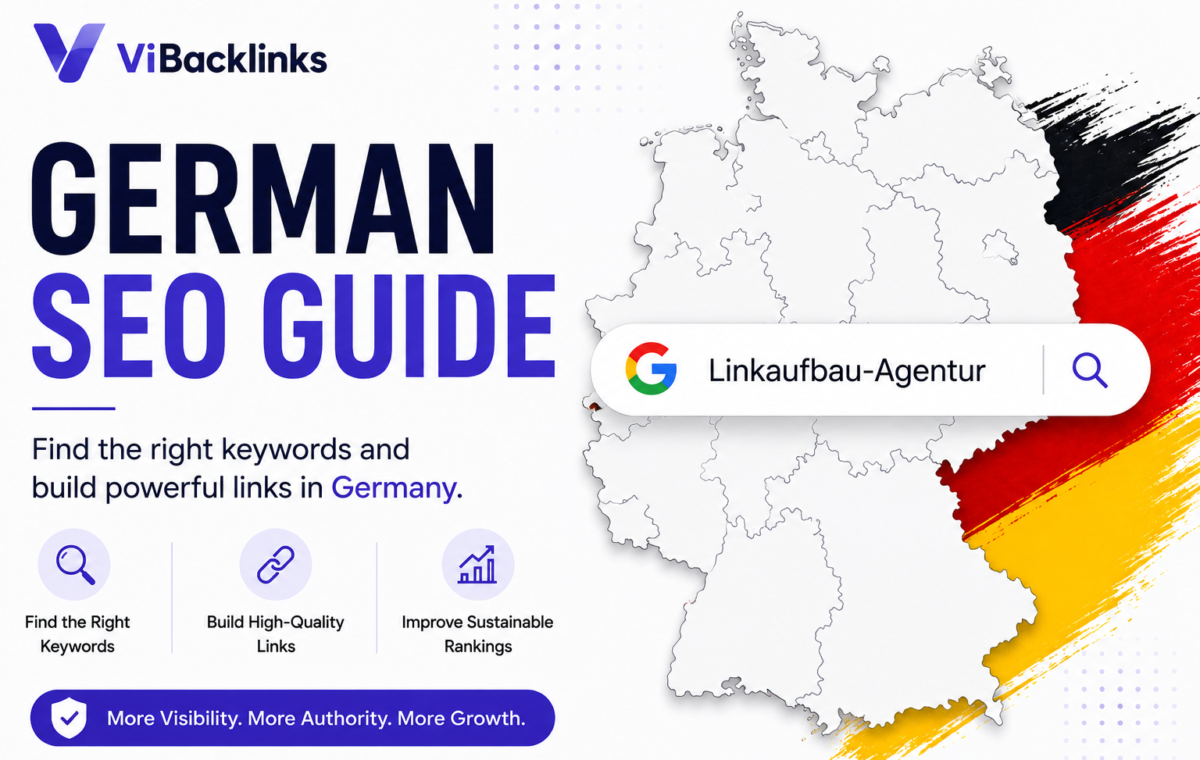
Germany is Europe’s largest economy and one of its most competitive search markets. Yet many international companies enter it with a translated English website and a copied keyword list, then wonder why rankings never arrive. This German SEO guide explains what actually changes when you optimize for German users: the language, the search behavior, the legal environment, and the link building culture. If you plan to compete in Germany or the wider DACH region, these fundamentals decide whether your investment pays off.
Why a German SEO Strategy Differs From English-Speaking Markets
Google dominates German search, so the technical playbook will feel familiar. What changes is everything around it. German users are privacy-conscious, skeptical of aggressive marketing, and quick to check whether a website looks legitimate. A missing Impressum — the legal site notice required on commercial websites under Section 5 of the German Digital Services Act (DDG), which replaced the older TMG in May 2024 — costs you trust instantly, because German visitors actively look for it. A sound German SEO strategy therefore treats compliance and credibility as ranking assets rather than afterthoughts in a market where buyers research carefully before acting.
German Keyword Research: Compound Words Change Everything
German builds long compound words. An English phrase such as “link building agency” becomes “Linkaufbau-Agentur,” which appears as one word, as a hyphenated form, or as separate words. Search demand splits across these variants, so keyword tools often underreport the true volume behind a German topic. Three practical rules follow:
- Research keywords natively instead of translating them. The direct translation of an English term is frequently not what German users type.
- Check every spelling variant of a compound term and group them into one topic cluster before judging demand.
- Test English loanwords alongside German terms. In professional and technical niches, English vocabulary is common in German queries.
One step matters most here: group the variants first, because they usually reveal a market larger than raw tool numbers suggest.
German Search Intent and Content Localization
Translation is not localization. German search intent leans toward detail, proof, and precision: buyers expect thorough comparisons, transparent pricing in euros, and content that references German realities rather than American examples. Thin marketing copy that performs acceptably in English markets tends to underperform in German results, where Google’s emphasis on helpful, people-first content meets an audience that genuinely prefers depth.
Formality is a real decision, not a stylistic detail. Business audiences generally expect the formal address “Sie,” while many consumer brands now use the informal “du.” Whichever you choose, apply it consistently across pages, because mixed forms read as careless and machine-translated. Localize your evidence too: German case studies, German units and conventions, and German cultural references all signal that the content was written for this market.
German Link Building and Outreach
Link building in Germany is slower, more selective, and more regulated than in most English-speaking markets. Two rules shape everything:
First, German law requires paid or sponsored content to be clearly labeled as advertising, typically with “Anzeige” or “Werbung.” Publishers who skip disclosure risk formal legal warnings, so reputable German websites insist on it. Second, Google’s spam policies state that bought links are only acceptable when qualified with sponsored or nofollow attributes; unmarked paid links intended to manipulate rankings violate those policies.
The practical consequence is that quality German placements come from genuine editorial relationships — and their value compounds beyond rankings: referral traffic from real readers, brand recognition in a skeptical market, and mentions that survive algorithm updates because they were never dependent on manipulating one. Outreach should be written in German, personalized, and respectful of the publisher’s standards, because generic English templates are widely ignored. Working with partners who already maintain established German publisher relationships can shorten this curve. Whoever handles your outreach, hold them to the same standards German publishers apply to themselves: topical relevance, editorial fit, and correct labeling of anything paid. An agency that cannot explain how its placements are disclosed has answered the question for you.
DACH Market Considerations
Germany, Austria, and Switzerland share a language but not a search market. Vocabulary differs between countries, Swiss Standard German replaces the ‘ß’ character with ‘ss,’ and users tend to trust local domains and locally adapted content. If you sell across the region, implement hreflang annotations for de-DE, de-AT, and de-CH, and adapt at least your money pages for each country. Serving one generic “German” page to three markets leaves rankings and conversions on the table.
Frequently Asked Questions
Is Google the main search engine in Germany? Yes. Google handles roughly nine out of ten searches in Germany, so standard Google optimization principles apply — the differences are in language, law, and user behavior, not the search engine.
Do Germans search in English or German? Overwhelmingly in German, though English loanwords are common in technical and professional queries. Research both, but never assume an English keyword list transfers.
Should I just translate my English keywords into German? No. Use translations only as a starting point, then research German queries natively, including compound-word variants and English loanwords, because direct translations often miss what Germans actually type.
Do I need an Impressum on my website for the German market? Yes, if your site is commercial and targets German users. It is required under Section 5 of the German Digital Services Act (DDG), and missing or incomplete notices can trigger fines and formal legal warnings.
Is buying backlinks allowed in Germany? Paid placements must be clearly labeled as advertising under German law — courts require the German terms “Anzeige” or “Werbung” — and Google requires rel=”sponsored” or rel=”nofollow” attributes on paid links. Anything less creates legal and search risk. Reputable providers build these requirements into every placement rather than treating them as negotiable.
Do I need separate websites for Germany, Austria, and Switzerland? Usually not. One site with correct hreflang targeting (de-DE, de-AT, de-CH) and country-adapted content is normally enough, but adapt at least your key commercial pages per country.
How long does SEO take to show results in Germany? Expect several months to a year in competitive niches, in line with Google’s own general guidance on SEO timelines. Be skeptical of anyone promising faster.
Conclusion
Successful German SEO comes down to respect for the market: research keywords the way Germans actually search, localize content instead of translating it, follow German disclosure law in every outreach campaign, and treat DACH as three related markets rather than one. International businesses that internalize these differences early consistently outperform those that arrive with an English playbook and a translation budget.