
Ask ten SEO tools how many backlinks it actually takes to rank and you will get ten different numbers. Ask Google, and you will get none. The uncomfortable truth: there is no fixed figure, and anyone who promises one is usually selling something. Google has never published a link target for any keyword, any industry, or any position. Its official documentation explains how links are judged — and that lets you work out a realistic estimate for your own pages instead of chasing a myth.
Why “How Many Backlinks It Actually Takes To Rank” Is the Wrong Question
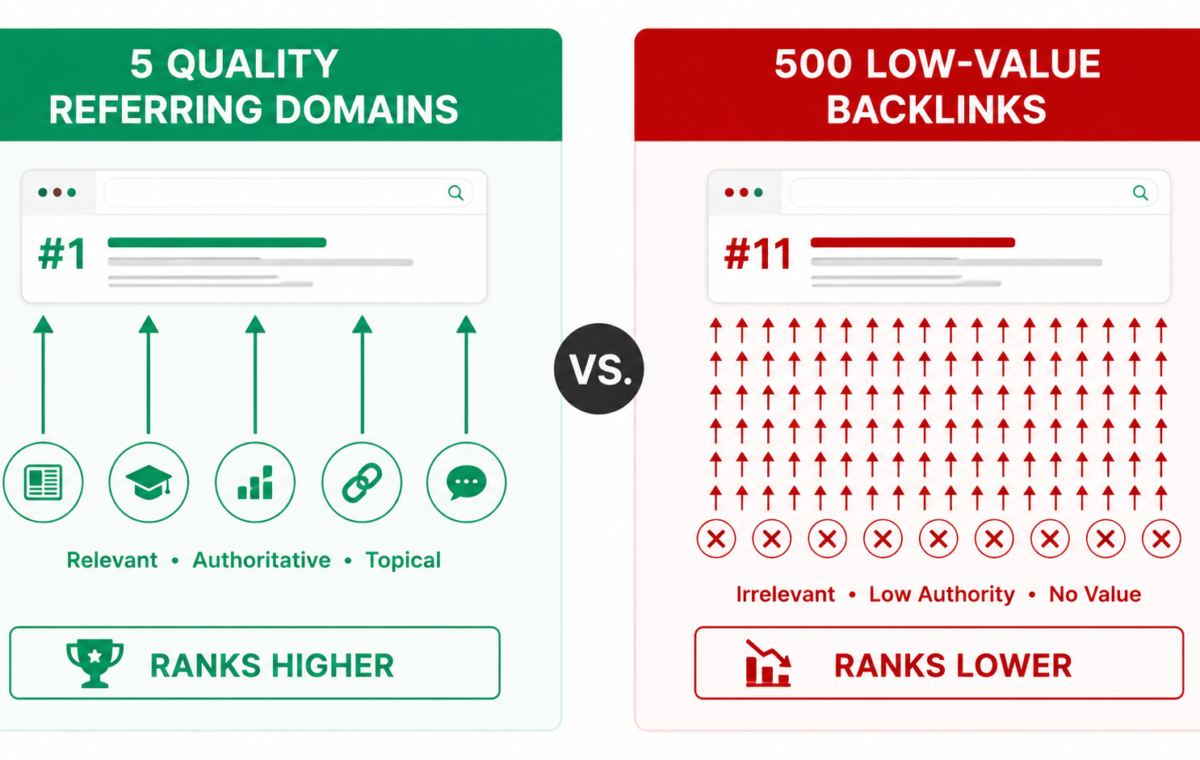
Google ranks individual pages, not backlink totals. A page supported by five relevant, editorially earned links from trusted sites routinely outranks a rival propped up by five hundred low-value ones. Since 2018, an AI-based platform called SpamBrain has analyzed patterns across billions of pages to detect manipulation, and Google reports that SpamBrain helps keep more than 99 percent of searches spam-free.
The quantity obsession also ignores everything that actually decides the outcome: keyword difficulty, the authority your domain already holds, the depth and usefulness of your content, how well the page matches search intent, and what the current top results have earned. Change any one of those variables, and the “number” changes with it.
What Google’s Official Documentation Says About Links
Google’s spam policies are direct on this point. Links intended primarily to manipulate rankings count as link spam, whichever direction they flow. Buying or selling links is not itself a violation — Google recognizes it as a normal part of web advertising — but only when those links carry a nofollow or sponsored attribute, which tells Google not to count them for ranking.
SpamBrain was also trained to detect both sides of the transaction: sites purchasing links and sites that exist mainly to pass them on. The consequence is harsher than most site owners realize. When Google neutralizes unnatural links, its documentation states plainly that any ranking benefit they once provided is lost and cannot be regained. Because this happens algorithmically rather than through a manual action, there is no penalty to lift and no reconsideration request to file. The value simply disappears, along with the budget spent acquiring it.
Worth knowing: Google’s June 2026 spam update, which rolled out from June 24 to June 26, was described by Google as a normal spam update with no new policies, and Google told industry press it did not target link spam. Google’s link spam rules themselves have not materially changed in years.
Referring Domains Matter More Than Raw Backlinks
One distinction clears up most of the confusion. A backlink is one link; a referring domain is one unique website linking to you. A hundred links from the same site are one vote, not a hundred. Any serious estimate should count referring domains — and only relevant, trustworthy ones. Topical relevance carries real weight too: a link from a publication in your own field says more about your authority than a technically stronger link from an unrelated one.
How to Estimate the Right Number for Your Keyword
Since no universal figure exists, use the method professionals rely on — competitor backlink analysis:
- Pull the current top ten pages for your target keyword.
- Count the referring domains pointing to each page, not to the whole domain.
- Take the median, which resists distortion from a single outlier.
- Discount irrelevant or low-quality domains from that count.
- Adjust downward if your content and site are stronger than the competition, upward if weaker.
The gap between that median and your own page is your realistic target. In our own outreach campaigns across English-speaking and European markets, this page-level gap has proven a far better predictor than any generic benchmark. Low-competition terms sometimes need almost nothing, while commercial national keywords demand steady earning over many months.
Realistic Expectations and Timelines
Links are not instant. Google’s documentation notes that improvement after fixing violations can take months while its systems learn that a site now complies. Fresh links follow a similar rhythm of crawling, evaluation, and gradual effect. Anyone promising page one in thirty days is making a claim Google itself would never make.
Frequently Asked Questions
How many backlinks do you need to rank on the first page of Google?
There is no fixed number, and Google has never published one. The realistic target is the median number of quality referring domains pointing to the current top-ranking pages for your specific keyword — which can be zero for long-tail terms and hundreds for competitive commercial ones.
Are 100 backlinks enough to rank a website?
The count alone means nothing. One hundred links from one low-quality site are weaker than five editorial links from relevant, trusted sites. Measure referring domains against your keyword’s top ten, not a raw backlink total.
Can a website rank without any backlinks?
Yes, for low-competition and long-tail queries where content strongly matches search intent. Competitive keywords almost always require earned authority from relevant referring domains.
How long does it take for backlinks to affect rankings?
Typically weeks to months. Google has published no timeline for links specifically, but its systems evaluate signals gradually as pages are recrawled — its own guidance on recovery describes changes taking effect over months, not days.
How many backlinks per month is safe to build?
Google publishes no monthly limit. Its policies prohibit manipulative links, not a particular pace. Links earned through genuine editorial interest carry no velocity risk; purchased links that pass ranking value violate policy at any pace.
Do paid backlinks still work in 2026?
Paid links that pass ranking value violate Google’s spam policies, and SpamBrain is trained to detect both buyers and sellers. Once neutralized, any ranking benefit is lost and cannot be regained. Paid placements are only compliant when marked nofollow or sponsored.
Conclusion
So, how many backlinks it actually takes to rank? Exactly as many quality referring domains as your specific keyword, competition, and content require — a figure you can estimate through competitor analysis but never read off a chart. Google’s official guidance is consistent: earn relevant links, avoid manipulation, and remember that spam value, once neutralized, never returns. Chase the method, not a magic number.